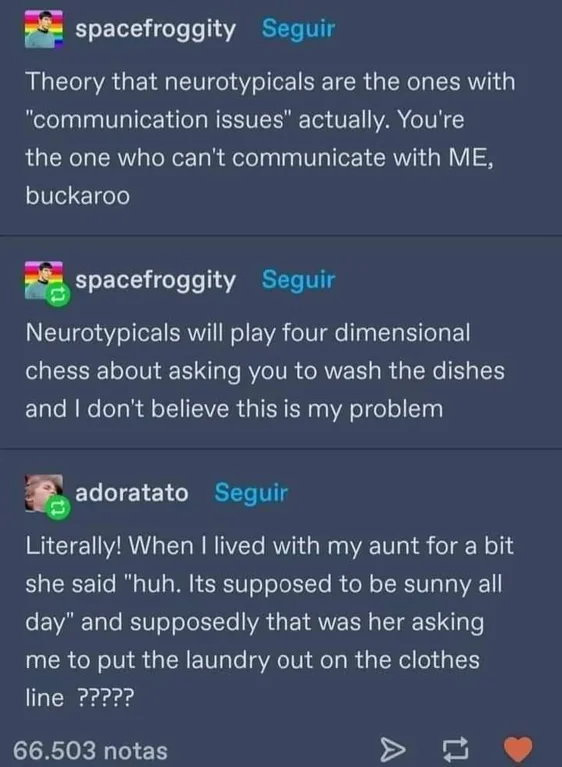
My serious answer as a neurotypical person is that it depends on what you mean by being better at communicating.
Is the goal is to communicate information in the clearest manner possible? Or is communication that is laden with ambiguity, irony, hierarchy etc., in short, social information that is supplementary to the literal meaning of the words, better because is more dense with meaning? And this is just considering verbal communication. Is a poem better the clearer its meaning is? There are lots of people who think so, even if I would disagree.
I think it depends on the situation, context and your own assumptions about what good communication is.
If you take the example above about the aunt wanting the clothes picked up, obviously this is pretty shitty at clearly communicating intention, and maybe she’s just bad at communicating generally. But it’s also plausible that this person felt like asking directly for whatever reason was too overbearing. Women are often socialized to avoid direct commands. In that case the communication much better matches the aunts intended goal of asking without asking, even if that message was not understood by the recipient.
This is the old pragmatics vs semantics issue.
Autistic people, speaking as one of them, tend to heavily focus on semantics in communication whereas allistic people tend to heavily focus on pragmatics.
Often autistic-coded characters in media make vulgar stereotypes of this divide and they’ll have their autistic-coded character be extremely pedantic about the semantics of communication in a condescending way, which is played off as the punchline.
But, as it is, there’s often a kernel of truth to stereotypes and this definitely tracks for autistic folks. (The first part though, not the condescension.)
What this means is that autistic people tend to miss a lot of the ancillary communication that goes on with allistic people that provides a lot of context, social cues, and signalling of intent and mood and other matters of social significance.
It’s a case of “I have investigated communication and it turns out that I meet my own priorities for communication better than others do” (shocking, I know!) and this goes both ways; I strongly suspect that allistic people often feel as though when communicating with autistic people, a lot of cues are missed and a lot of the implied meaning goes over the autistic person’s head (or worse yet, it’s interpreted as the autistic person intentionally ignoring these signals and the autistic person is considered as being rude or arrogant.)
Essentially so much of this boils down to a matter of what emphasis and purpose autistic/allistic people have for communication.